
How StrydAR works
StrydAR utilizes visual cueing—a well-established Parkinson’s technique—and delivers it seamlessly through your upper peripheral vision.
A visual cue, placed exactly where your brain needs it.
Visual cueing works by giving the brain a specific target to step toward. Traditionally, this might be lines painted on a clinic floor, specific tile patterns, or external markers.
StrydAR miniaturizes this concept. The glasses project a stable, high-contrast visual cue directly into your upper peripheral vision. This allows your brain to pick up the signal naturally and continuously, without requiring you to look down, hunch over, or change how you walk.

Why StrydAR is more consistent than traditional cueing
Always available
There is no need to rely on specific floor markings, indoor tiles, or laser attachments. The cue is always active inside the lens.
Positioned correctly
Because the cue sits in the upper peripheral vision, it influences movement naturally without forcing you to look at the ground.
It works everywhere
Designed to be used outdoors, indoors, in shops, and on pavements—giving you support in the real world, not just in controlled clinic settings.
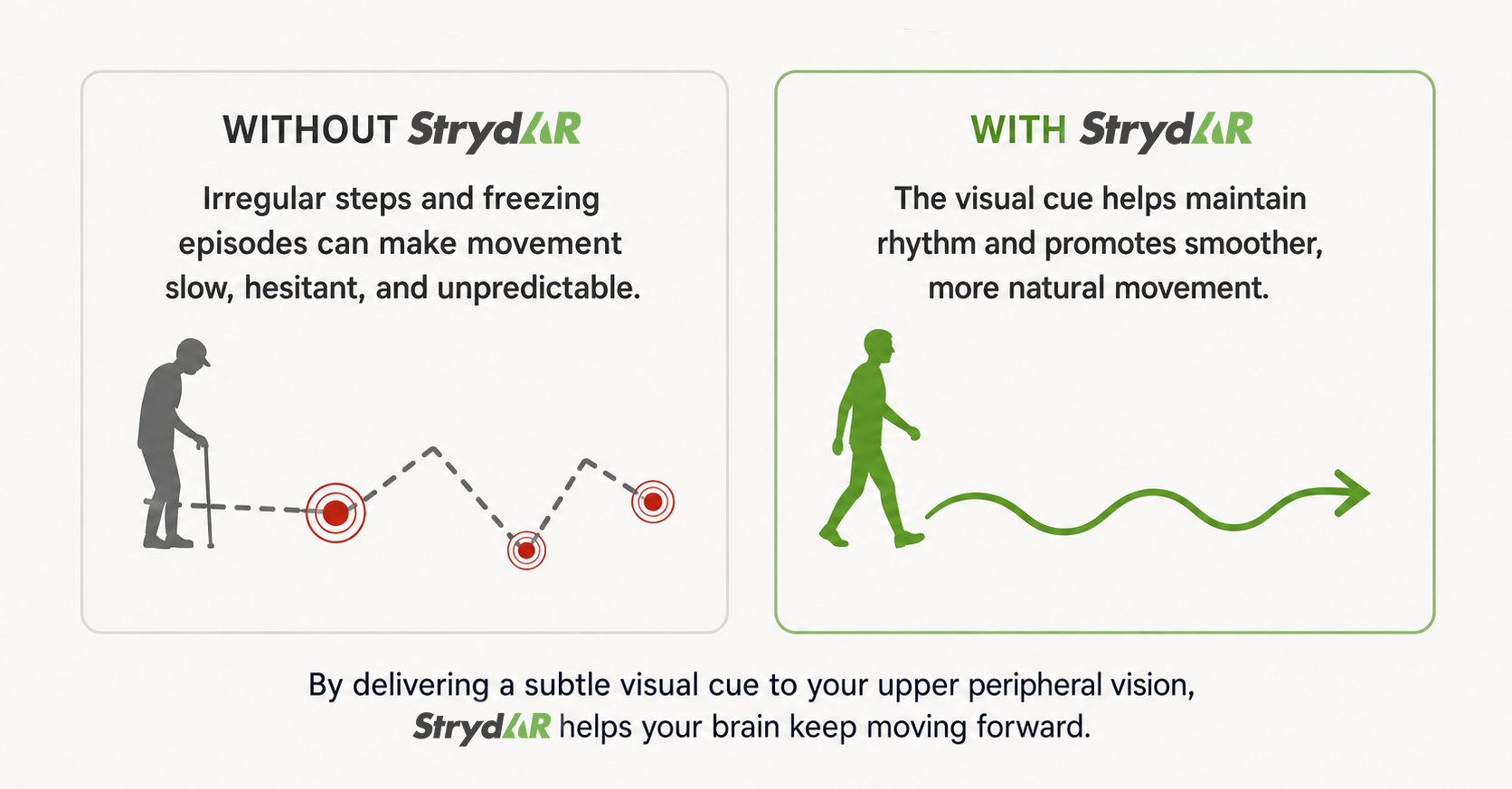
Visualizing the impact
The presence of a consistent, high-contrast visual cue helps the brain maintain a steady walking rhythm and overcome gait freezing.
Safety and medical status
CE Marked
Conforms to EU medical device standards
UKCA Approved
Recognised UK medical device certification
Non-invasive
No surgery, no implants, no medication changes
Holistic care
Works alongside your existing treatment
StrydAR does not replace medication, physiotherapy, or clinical care. It is an adjunctive therapy designed to complement your existing Parkinson’s treatments.
Because it uses optical stimulation, it does not interfere with your medication timing or efficacy, allowing it to be integrated seamlessly into your daily routine exactly when you need it.
The Science & Clinical Evidence
Want to dive deeper into how this works? Read our comprehensive overview on the neuroanatomy, neurophysiology, and clinical evidence supporting visual cueing for Parkinson's Disease.
Who StrydAR may help
- Experience freezing of gait or severe hesitation.
- Feel unsteady, shuffle, or lack balance when walking.
- Want more confidence moving around public spaces.
- Are able to walk independently (even with a stick).
When StrydAR may not be right
- Require full physical walking assistance or a wheelchair.
- Cannot safely walk independently or stand unaided.
- Are looking for a permanent cure or pharmacological treatment.